Speaking before the House of Representatives on Tuesday, Madbouly reviewed government and economic performance during the first half of FY2025/2026, covering the period from July to December 2025, before the outbreak of the Iran war, as well as the measures taken by the state to deal with its impact.
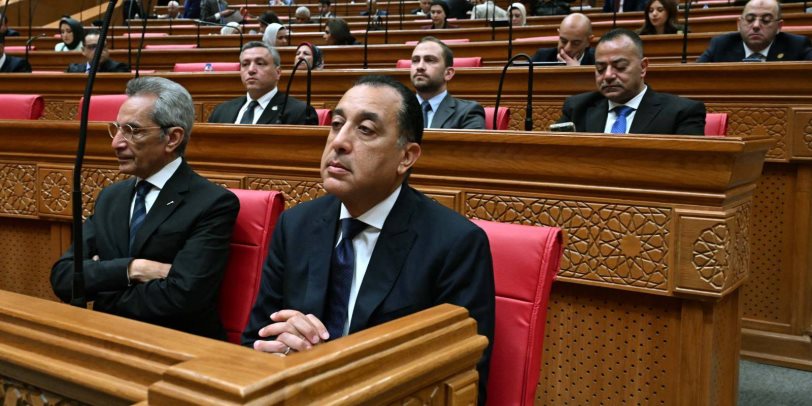
Prime Minister Mostafa Madbouly said the government completed 19 full and partial divestment transactions involving companies and assets across the four phases of the state offerings program through June 2025, generating around $6 billion in proceeds, or about 48% of the $12.2 billion target.
Speaking before the House of Representatives on Tuesday, Madbouly reviewed government and economic performance during the first half of FY2025/2026, covering the period from July to December 2025, before the outbreak of the Iran war, as well as the measures taken by the state to deal with its impact.
He said Egypt’s economy grew by 5.3% during the first half of the fiscal year, supported by strong performance in industry, agriculture, information technology, and tourism, alongside higher private sector investment.
Madbouly added that net foreign direct investment inflows reached $9.3 billion during the first half of the current fiscal year, compared with around $6 billion in the same period a year earlier.
He also said the current account deficit narrowed by 13.6% to about $9.5 billion, down from $10.9 billion in the corresponding period of the previous fiscal year.
Remittances from Egyptians working abroad rose by 29.6% to $22.1 billion during the period from July to December 2025, compared with $17.1 billion in the same period of the previous fiscal year. Tourism revenues also increased by 17.3% to $10.2 billion, up from $8.7 billion, reflecting the sector’s recovery.
Madbouly noted that the Finance Ministry has adopted a strategy to reduce external debt by around $1 billion to $2 billion annually. He said external debt had already been cut by about $3.9 billion from June 2023 through early April 2026.
Madbouly said the government’s forward plan is based on continuing to support economic activity through the implementation of the 2026-2027 economic and social development plan, which includes total investments estimated at EGP 3.8 trillion and aims to strengthen the private sector’s role as a driver of growth by raising its share of total investments to 60%.
He added that one of the main priorities is to maximize the use of new and renewable energy, describing it as the best path to strengthen the resilience of the national economy by reducing dependence on conventional fuels and creating a balanced energy mix. He said the government has expanded renewable energy projects in a systematic and carefully planned way over recent years.
“In this context, we have achieved an unprecedented leap in renewable electricity generation capacity, which rose from 5,934 megawatts in 2020 to 9,366 megawatts in 2025,” Madbouly said.
He added that 2026 will see the addition of 2,500 megawatts of renewable energy, along with 920 megawatts of battery storage connected to the unified grid, helping strengthen the sustainability and stability of the national electricity system.
Madbouly said the government is targeting for 45% of Egypt’s total energy output to come from renewable sources by 2028, supporting the country’s ambition to become a leading regional hub for green energy. He noted that achieving this goal would save up to $7 billion annually in gas imports needed for conventional power plants.
He added that the government is working to secure all the financial resources needed for this strategy and has placed it high on its list of priorities, including upgrading and improving the efficiency of electricity grids and transmission lines at a cost of around EGP 200 billion to accommodate power generated from renewable sources.
The prime minister also said the government is offering more incentives and facilitations to attract additional investments and projects, while allocating land for the expansion of such projects across the country.
Madbouly said another future priority is to maximize oil and gas discoveries. He explained that the government is pursuing this through several steps, including settling all dues owed to foreign partners by June 2026, after they stood at $6.1 billion in June 2024, while also committing to the regular payment of new monthly dues.
He said the plan also includes accelerating research, exploration, and drilling to boost domestic production and shorten the time between discovery and output, helping reduce the foreign currency used to import petroleum products.
Madbouly added that the government is also seeking to reposition the Egyptian economy within regional and global value chains in a way that supports food and energy security, while making better use of the competitive advantages of several sectors to attract investment and create high-value jobs.
On food security, he said the government is currently working to narrow the import gap and better secure its strategic needs. Egypt is targeting the delivery of around 5 million tons of local wheat from farmers during the current harvest season, while the local procurement price has been set at EGP 2,500 per ardeb, up EGP 300 from the previous season, alongside continued diversification of import sources.